Beam vs Origami Agents: The Honest Comparison
Is your bidding pipeline suffering from the "manual estimation bottleneck" that drains your senior talent's time?
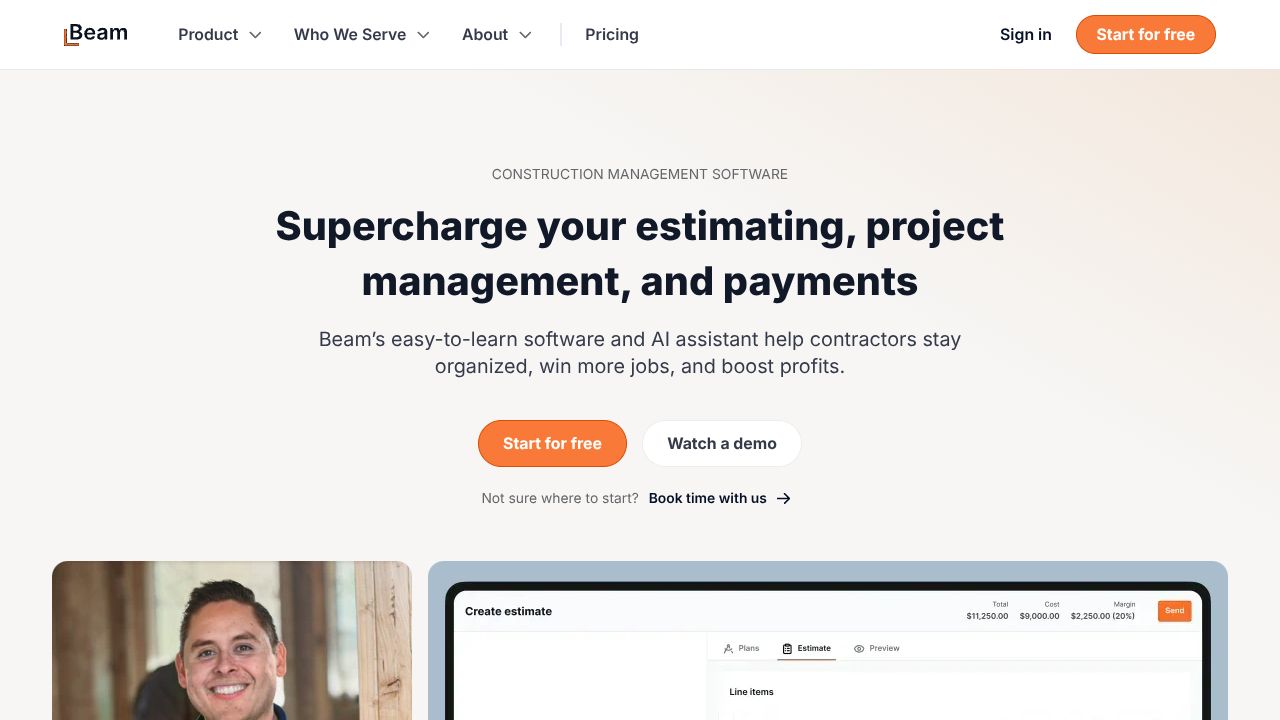
At Fine Tuned Chaos, we’ve spent years watching AI move from experimental labs to the front lines of heavy industry. Beam represents a critical shift in construction tech, transforming the traditionally grueling process of plan scanning and site note processing into a streamlined, AI-driven drafting workflow. For leadership, this isn't just a new tool; it’s the end of guesswork in conceptual bidding, allowing your team to move from uploaded plans to accurate estimates in minutes rather than days.
Bridging the Gap Between Blueprints and Bottom Lines
The business case for Beam centers on the most expensive resource in any construction firm: the estimator's time. Traditionally, senior builders spend hours manually calculating quantities and costs from site notes or complex PDFs. Our team’s analysis suggests that by implementing Beam, firms can pivot from a defensive "catch-up" posture to an aggressive bidding strategy. In a high-interest-rate environment where project margins are razor-thin, the ability to produce rapid, accurate conceptual estimates provides a massive competitive edge.
We’ve found that the real ROI isn't just in the speed of the estimate, but in the capture of more opportunities. When your team can respond to an RFP in a fraction of the time, your "top of funnel" project volume expands without a linear increase in overhead. Beam positions itself as a vertical-specific automation layer that understands the nuances of construction language—something general-purpose AI often misses. By integrating directly into the builder’s workflow, it ensures that data doesn't just sit in a silo but actively drives the procurement and bidding cycle forward.
Strategic Value Drivers
- Operational Efficiency: Beam eliminates the manual "takeoff" phase by scanning uploaded plans and site notes automatically. This allows your technical staff to focus on high-level strategy and client relationships rather than data entry.
- Cost Impact: By reducing the hours spent per bid, firms can significantly lower their customer acquisition costs (CAC). Accurate quantity calculations also mitigate the risk of under-bidding, which is often the silent killer of project profitability.
- Scalability: As your firm grows, Beam allows you to scale your bidding capacity without a proportional increase in headcount. It provides a standardized framework for estimates that ensures consistency across different project managers and regions.
- Risk Factors: Leaders should remain mindful of the "black box" nature of automated scanning; while Beam is highly accurate, a human-in-the-loop verification process remains essential to catch architectural anomalies that AI might misinterpret.
Navigating the Deployment Phase
Implementing Beam requires more than just a software subscription; it demands a shift in how your pre-construction team operates. We recommend a phased rollout, starting with "shadow bidding"—running Beam alongside your manual process for 30 days to calibrate accuracy against your historical data. Integration is relatively straightforward as the platform is designed to ingest standard plan formats and site notes, but the real challenge lies in change management.
Your senior estimators may initially view AI as a threat to their expertise. However, the goal is to position Beam as an "assistant" that handles the grunt work, liberating them to apply their professional judgment where it matters most: risk assessment and value engineering. From a technical standpoint, ensure your site note capture process is standardized (digital notes vs. messy handwriting) to maximize the AI’s ingestion quality. The infrastructure is cloud-based, meaning the heavy lifting of machine learning happens off-site, requiring minimal internal IT overhead.
The Automation Ecosystem: A Comparative View
Beam enters a market where automation is becoming the standard, but its vertical focus sets it apart. While Origami Agents excels at managing complex sales logic and lead follow-ups through autonomous loops, Beam is hyper-focused on the physical realities of construction plans. For firms looking for a broader organizational overhaul, Creatio offers a robust low-code platform to automate CRM and general business workflows, but it lacks the specialized "computer vision" for blueprints that Beam provides.
Similarly, if your primary bottleneck is generating new business leads rather than estimating the ones you have, HeyReach provides superior multi-channel outreach capabilities for LinkedIn and email. However, for the builder who already has a stack of plans on their desk and needs to know the cost now, Beam’s ability to move from "upload to estimate" is a specialized capability that general sales or CRM tools cannot replicate.
The Algorithm Alchemists’ Verdict
We recommend that construction executives initiate a pilot program for Beam immediately, specifically within the conceptual bidding department. Start by identifying your most time-consuming estimate types and let Beam draft the initial versions. Monitor the delta between the AI’s output and your final bids. If you can reduce bid turnaround time by even 30%, the cumulative impact on your project win rate will be transformative. Don't wait for the "perfect" model—start experimenting with production reality today.