Gong.io's AI Engine: The Science Behind Sales Intelligence Evolution
The Black Box of the Frontline: Why Revenue Intelligence is No Longer Optional
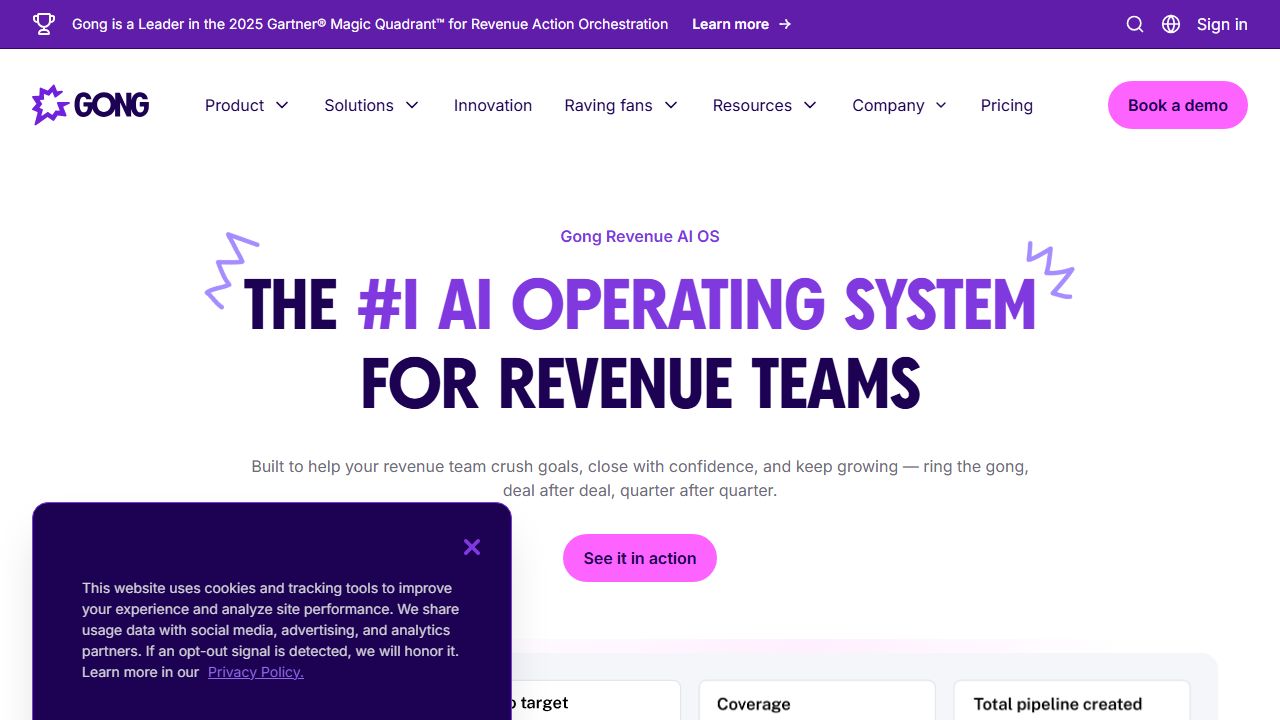
You know the drill—your sales team is logging record activity, yet your quarterly forecast remains a game of high-stakes guesswork based on subjective "gut feelings" from mid-level managers. You’re pouring millions into R&D and marketing, but the actual moment of value exchange—the sales conversation—remains a dark room where critical market signals vanish into thin air the moment the Zoom call ends. Gong.io illuminates this void by leveraging advanced Natural Language Processing (NLP) to transform unstructured voice data into a strategic asset. For AI leaders, it represents the shift from reactive reporting to proactive, data-driven revenue operations.
The Business Case: Turning Conversations into Structured Capital
At Fine Tuned Chaos, we’ve spent years debating the "last mile" problem of AI—how to take sophisticated models and actually move the needle on the P&L. Gong.io is one of the few platforms we’ve seen that successfully bridges this gap by treating every customer interaction as a data point for a larger machine-learning engine.
The competitive advantage here isn't just "better notes"; it’s the ability to identify the "winning DNA" of your top performers. By analyzing talk ratios, sentiment, and objection-handling patterns across thousands of hours of audio, Gong provides a quantitative map of what a successful deal looks like. We’ve found that for enterprise leaders, this moves the needle on two fronts: shortening the ramp-up time for new hires and increasing the overall win rate by institutionalizing the tactics of your top 5% of reps. In a market where customer acquisition costs are skyrocketing, the ability to extract high-fidelity "Breakthrough Stories" from your own data is a massive force multiplier. It turns your sales organization into a self-learning system that evolves with every call.
Key Strategic Benefits
- Operational Efficiency: Gong removes the administrative burden of manual CRM entry by syncing insights directly to platforms like Salesforce and HubSpot. This allows your talent to focus on high-value strategic selling rather than data entry, effectively recapturing lost hours across the entire go-to-market org.
- Cost Impact: By identifying "at-risk" deals through sentiment analysis and engagement tracking long before they fall out of the pipeline, Gong acts as an early-warning system for revenue leakage. We've observed that this predictive capability significantly reduces the cost of customer acquisition by optimizing the sales cycle length.
- Scalability: The platform allows a single sales manager to "shadow" hundreds of calls simultaneously through automated dashboards and keyword alerts. This enables a lean management structure to maintain high quality-control standards even during periods of rapid aggressive head-count growth.
- Risk Factors: The primary hurdles are data privacy and regional compliance (such as GDPR or two-party consent laws), necessitating a robust legal review before deployment. Furthermore, there is a risk of "culture shock" if the implementation isn't framed as a coaching tool rather than a surveillance mechanism.
Navigating the Integration Maze
Implementing Gong.io is less of a technical challenge and more of a change-management exercise. From a technical standpoint, the integration with Zoom, Google Meet, and major CRMs is relatively seamless, typically taking a few weeks to fully ingest enough data to provide meaningful baseline trends. However, the real work lies in the "Fine-Tuning" of the AI to recognize your specific industry jargon, competitor names, and unique value propositions.
We recommend a phased rollout: start with a high-performing pilot group to establish "success benchmarks." Your data science or RevOps team will need to spend time in the first 30 days auditing the AI’s categorization of "objections" to ensure the sentiment analysis aligns with your specific market nuances. The goal is to move from "Experiment Logs" to "Production Reality" within one fiscal quarter, ensuring the leadership team has a clear dashboard of "Buying Signals" that can inform broader corporate strategy and product roadmaps.
Mapping the Conversation Intelligence Territory
The market for AI-driven sales intelligence is tightening, and while Gong.io is a dominant force in the enterprise space, it isn't the only player on the field. Leaders must weigh Gong’s deep analytical capabilities against specialized alternatives that might better fit specific tech stacks or budget constraints.
For organizations deeply embedded in the Microsoft ecosystem, Viva Sales offers native integration that is hard to ignore. If your primary focus is on high-velocity, high-volume transactional sales, Chorus.ai provides a compelling alternative with a heavy emphasis on conversation momentum. Meanwhile, for smaller teams looking for transcription-first tools that are lighter on the wallet, Otter.ai or Grain may serve as entry-level points before graduating to a full revenue intelligence suite. Gong sets itself apart by moving beyond simple transcription into deep, multi-call trend analysis that informs executive-level decision-making.
Recommendation: The Path Forward
If your organization is currently managing a pipeline based on anecdotal evidence, your first step is a 30-day "Reality Audit" using Gong on a subset of your enterprise accounts. We suggest tasking your RevOps lead with identifying three specific "Failure Post-Mortems" where Gong’s data reveals a discrepancy between the rep's notes and the actual call sentiment. Once the value of this "ground truth" data is proven, move toward a full-scale integration to turn your sales conversations into a structured strategic asset.