PlanSwift: A Complete Guide for Artificial Intelligence Professionals
Turning Blueprint Clicks into Bid Intelligence
Ever spent days reconciling takeoffs, only to find your bid margins evaporate post-award? Our team sees this pattern across construction portfolios: manual takeoffs create latency, variance, and data black holes that stall AI adoption. PlanSwift turns blueprint interactions into structured, real-time cost data—accelerating bids today while creating the experiment logs your AI program needs tomorrow. Bottom line: it’s both a profit lever and a data engine.
The Business Case
For AI leaders in construction, PlanSwift matters because it converts unstructured blueprints into measurable, repeatable estimating workflows. That shift yields two compounding advantages. First, near-term ROI: faster digital takeoffs, fewer manual errors, and tighter estimates that protect contribution margin. Second, strategic data assets: every click, annotation, and assembly choice becomes part of a durable dataset that can fuel ML models, copilots, and decision-support systems.
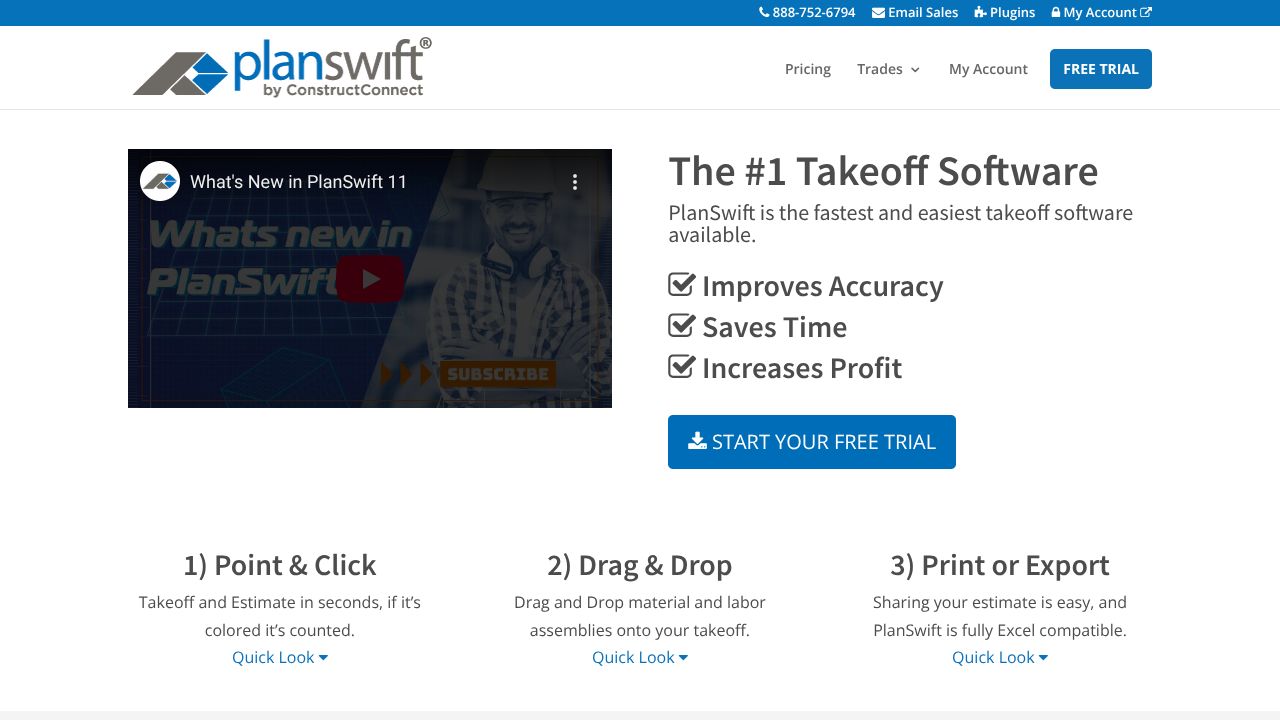
We frame PlanSwift as a “data exhaust accelerator.” Its point-and-click takeoff, drag-and-drop assemblies, and real-time cost calculations standardize estimator behavior, reducing variance between individuals and enabling high-fidelity benchmarks across projects, trades, and geographies. Leaders can then run controlled experiments—A/B test assemblies, re-price inputs, or evaluate markup strategies—supported by precise experiment logs that survive tool and team transitions. In an industry where timing and accuracy drive win rates, PlanSwift tightens your bid cycle while creating the labeled examples necessary for future fine-tuning guides and failure post-mortems. This is where AI experiments meet production reality.
Key Strategic Benefits
-
Operational Efficiency: PlanSwift compresses takeoff-to-estimate time by centralizing measurement, assemblies, and cost roll-ups in one visual interface. Our team values how this standardization shrinks handoffs between estimators, project managers, and subcontractors through shared markups and annotations.
-
Cost Impact: Automated quantity takeoffs and trade-specific assemblies reduce miscounts and pricing drift, directly improving bid precision and margin capture. Leadership gains clearer visibility into estimate vs. actual variances, enabling targeted interventions on high-leakage scopes.
-
Scalability: Because PlanSwift supports multiple file formats (PDF, DWG, images) and trade plugins, it adapts across small shops and enterprise GC portfolios. Standard libraries of assemblies scale institutional knowledge, minimizing skill-based variability as teams grow or rotate.
-
Risk Factors: Unknown pricing introduces TCO uncertainty; leaders should model license, training, and integration costs against cycle-time gains and rework reduction. Consider governance for approval workflows and audit trails—especially if estimates become training data for AI assistants.
Implementation Considerations
We recommend a 60–90 day rollout: weeks 1–3 for configuration, weeks 4–6 for pilot, weeks 7–12 for scale. Start by curating trade-specific assemblies and cost libraries to reflect your cost codes, labor rates, and markup rules. Instrument the platform from day one: capture estimator actions, measurement metadata, version histories, and outcome labels (won/lost bids, variance to actuals). Those logs become your backbone for fine-tuning guides and failure post-mortems.
Change management is nontrivial. Stand up a core team (estimating lead, PM, data/AI product owner) and run structured playbooks: short-form training, side-by-side comparisons with legacy methods, and A/B testing of assemblies to quantify gains. Integration-wise, plan for export/import with your ERP, job-costing, and document control systems; even if native integrations are limited, CSV/API pipelines combined with data catalogs can build reliable flows. Define role-based permissions and a review process to ensure consistency across offices and subcontractors.
Competitive Landscape
While ProEst excels at cloud-native estimating and deeper cost analytics out of the box, PlanSwift is better suited for teams prioritizing rapid, visual takeoffs with immediate quantification on digital plans. If your objective is an end-to-end commercial stack that ties estimating to invoicing and light project management, Estimate Rocket may streamline downstream processes; PlanSwift, by contrast, focuses on the high-precision front-end where takeoff speed and accuracy matter most. For small builders seeking all-in-one estimating plus job costing, Buildxact offers simplicity; PlanSwift is stronger for trade-specific assemblies and blueprint-driven workflows. Pricing for PlanSwift is undisclosed—cost modeling will be vital in head-to-head evaluations.
Recommendation
- Launch a controlled pilot on 2–3 active bids across different trades; baseline cycle time, rework, and estimate-to-actual variance.
- Establish experiment logs: capture actions, assemblies used, overrides, and outcomes to inform future fine-tuning of an estimator copilot.
- Run weekly failure post-mortems on lost bids or variance outliers; codify learnings back into assemblies and pricing rules.
- Build a 12-week roadmap: integration points, governance standards, and a data schema designed for downstream ML.
- If you need broader ERP tie-ins now, benchmark against ProEst, Estimate Rocket, and Buildxact; otherwise, prioritize PlanSwift for its takeoff speed-to-data advantage.